Please wait...
Corded Curtain Rail: The Complete Guide to Corded Curtain Tracks
This entry was posted 21/07/2026
What They Are, How They Work, Their Pros & Cons, and How to Choose the Right One
If you're searching for a corded curtain rail, you've probably also come across the term corded curtain track. It can be confusing, particularly as both terms are often used to describe the same product.
In most cases, they are exactly the same thing. Homeowners commonly refer to them as curtain rails, while manufacturers and professional installers tend to use the term curtain tracks. Both describe a system that allows curtains to glide smoothly along a fixed profile. When operated using a continuous pull cord rather than by hand, they're known as corded curtain rails or corded curtain tracks.
At The Curtain Pole & Track Company, we've spent decades manufacturing made-to-measure curtain tracks for homeowners, interior designers and professional installers across the UK. One thing we've learned is that selecting the right operating system makes a huge difference to how your curtains perform, not just on the day they're installed, but for many years afterwards.
In this guide we'll explain everything you need to know about corded curtain rails, including how they work, where they perform best, their advantages and disadvantages, installation advice, common mistakes to avoid and the questions we're most frequently asked.
What is a Corded Curtain Rail?
A corded curtain rail (or corded curtain track) is a curtain track fitted with an internal cord and pulley mechanism that allows the curtains to be opened and closed without touching the fabric.
Rather than pulling the curtain itself, you simply operate the continuous cord loop positioned at one end of the track. Inside the profile, the cord moves the master carriers, allowing the curtain gliders to travel smoothly from one end of the track to the other.
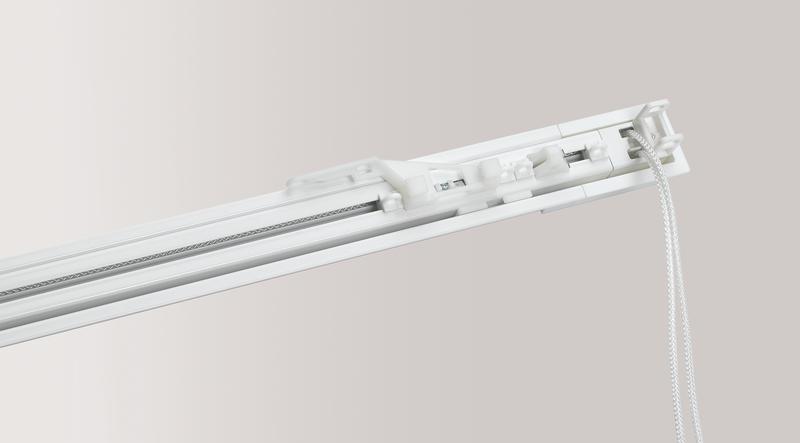
Although the mechanism is relatively simple, a well-manufactured system should feel effortless to operate. Even large, heavy curtains can usually be opened with very little force.
One of the biggest benefits is that the curtain fabric is rarely handled. This helps reduce finger marks, stretching and wear, particularly on lined, interlined and luxury curtain fabrics.Many of our customers specifically choose a corded system because they've invested in beautiful bespoke curtains and want to keep them looking their best for as long as possible.
Why Do Some People Say Curtain Rail and Others Say Curtain Track?
This is one of the questions we're asked most often. Traditionally, a curtain rail described almost any system used to hang curtains, while curtain track became the preferred industry term for the aluminium profile that the curtain gliders run inside. Today, the two names are largely interchangeable. Homeowners are much more likely to search online for:
- Corded curtain rail
- Curtain rail with cord
- Pull cord curtain rail
Whereas installers, interior designers and manufacturers generally use terms such as:
- Corded curtain track
- Aluminium curtain track
- Made-to-measure curtain track
Whichever term you use, you're generally referring to the same type of operating system.
How Does a Corded Curtain Rail Work?
The operating cord runs around a series of hidden pulleys inside the track. As you pull the cord:
- the master carrier moves along the track
- the curtain gliders follow behind
- the curtain opens or closes smoothly
- the fabric remains untouched
Many premium curtain tracks also incorporate an overlap arm, allowing the leading edges of the curtains to overlap neatly in the centre. This reduces light gaps while creating a smarter finished appearance.
Why Choose a Corded Curtain Rail?
Although motorised curtain tracks continue to grow in popularity, corded systems remain one of the most reliable and practical options available. They're particularly well suited to:
- Large windows
- Bay windows
- Patio and bifold doors
- Heavy curtains
- Floor-to-ceiling curtains
- Hotels
- Care homes
- Period properties
- Luxury residential projects
As there are no motors or electronics involved, quality corded systems provide years of dependable operation with very little maintenance.
The Advantages of a Corded Curtain Rail
Smooth, Effortless Operation
One of the biggest advantages of a corded curtain rail is how much easier it makes opening and closing your curtains, particularly on wider windows or where heavier fabrics are used.
Rather than pulling directly on the curtain, the internal cord and pulley mechanism moves the master carriers along the track for you. This helps the curtains glide more evenly and reduces the amount of effort needed during everyday use.
A corded system can be particularly beneficial because it:
Makes heavy curtains easier to move - lined, interlined and full-length curtains can be surprisingly heavy. The cord mechanism helps distribute the movement along the track, so you do not need to pull or tug at the fabric.
Reduces strain on the curtain fabric - repeatedly pulling curtains by hand places pressure on the leading edge, hooks and heading. Operating them by cord helps minimise stretching, pulling and unnecessary wear.
Helps protect the track and gliders - forceful or uneven hand-pulling can cause curtains to snag or place additional pressure on the gliders. A corded system creates a smoother, more controlled movement.
Provides more even opening and closing - the master carriers guide the curtains along the track, helping both sides meet neatly in the centre or stack back evenly when open.
Makes difficult-to-reach curtains easier to operate - tall windows, bay windows and curtains positioned behind furniture can be awkward to reach. A conveniently placed operating cord allows you to control the curtains from one accessible point.
Improves everyday usability - curtains are often opened and closed twice a day. A system that operates smoothly and consistently can make a noticeable difference, especially on larger installations.
We often recommend corded systems for wide windows, bay windows and heavier curtains because the mechanism takes much of the effort out of daily operation while helping protect both the curtains and the track over time.
Ideal for Bay Windows
Bay windows are one of the most popular applications for a corded curtain rail, and it's easy to see why. Unlike a straight window, a bay requires the curtains to travel smoothly around one or more bends, which can make hand-drawn curtains more difficult to operate.
With a corded curtain track, the internal pulley system helps guide the curtains around each curve, reducing the effort needed to open and close them. Instead of reaching behind furniture or pulling directly on the fabric as it negotiates the bends, you simply operate the cord from one convenient position.
A corded system offers several advantages for bay windows:
Smoother operation around bends - A professionally bent track allows the curtain gliders to move continuously around corners, helping to reduce snagging and uneven movement.
Easier everyday use - Bay windows are often positioned behind sofas, dining tables or window seats, making it awkward to reach the curtains by hand. A pull cord allows you to operate the entire curtain from one accessible location.
Better for larger or heavier curtains - Bay windows are typically wider than standard windows and often require more fabric. The cord mechanism takes much of the effort out of moving heavier curtains around multiple bends.
Protects your curtain fabric - Pulling curtains around a bay by hand can place additional strain on the leading edge of the fabric. Using the cord instead helps minimise handling and unnecessary wear.
At The Curtain Pole & Track Company, we've supplied made-to-measure curtain tracks for everything from traditional Victorian bays and elegant Edwardian homes to modern curved glazing and contemporary extensions. From our experience, the key to smooth operation isn't just choosing a corded system—it's ensuring the track is accurately bent and manufactured to the exact shape of your window. When specified correctly, your curtains should glide effortlessly around every bend for years to come.
Better Light Control, Privacy and Energy Efficiency
Many premium corded curtain tracks are fitted with an overlap arm. This small but important feature allows the leading edges of the curtains to overlap neatly in the centre of the window, rather than simply meeting edge to edge.
Although it's a simple piece of engineering, it can make a noticeable difference to both the appearance and performance of your curtains.
The benefits include:
Fewer light gaps - By overlapping the curtain edges, less daylight can pass through the centre of the window. This is particularly beneficial in bedrooms, media rooms or anywhere improved light control is important.
Improved privacy - The overlap creates a more complete seal when the curtains are closed, helping to reduce visible gaps and making it more difficult to see into your home, especially after dark.
Better thermal performance - While curtains won't replace insulation, reducing gaps at the centre of the window helps minimise draughts and allows the curtains to form a more effective barrier against heat loss during the colder months.
Enhanced blackout performance - If you're using blackout-lined curtains, an overlap arm helps maximise their effectiveness by reducing the strip of light that can otherwise appear where the curtains meet.
A neater, more professional finish - As well as improving performance, overlap arms help the curtains close evenly and create a fuller, more elegant appearance across the entire window.
From our experience, this is one of those features that many customers don't initially consider, but once they've lived with a curtain track fitted with an overlap arm, they quickly appreciate the difference it makes. It's a small detail that contributes to smoother operation, better light control and a more polished overall finish.
Are There Any Disadvantages?
Like every curtain system, corded tracks aren't perfect.
Child Safety
All cord-operated window furnishings should be fitted with an approved cord tensioner to keep the operating cord safely secured and out of reach of young children. Modern installations are designed with child safety in mind and should always follow the manufacturer's instructions.
Eventually, the Cord May Need Replacing
Operating cords last for many years, but they're still a working component. Like anything used every day, they will eventually wear. Fortunately, replacement cords are available for most quality curtain tracks, making refurbishment far more economical than replacing the entire system.
Is a Corded Curtain Rail Right for You?
Ask yourself:
- Are your curtains particularly heavy?
- Is your window unusually wide?
- Is it a bay window?
- Do you want to avoid touching the curtain fabric?
- Will the curtains be opened every day?
If you've answered yes to several of these questions, a corded curtain rail is likely to be an excellent choice.
Choosing the Right Curtain Track
Don't Just Measure the Window
One of the biggest mistakes we see is choosing a curtain track purely based on window width. In reality, the weight of the finished curtains is often much more important. A pair of lined velvet curtains can weigh several times more than lightweight voiles covering exactly the same opening. Matching the track to the curtain weight ensures smoother operation and a longer service life.
Made-to-Measure or Adjustable?
Adjustable tracks can work well for temporary installations. However, if you've invested in made-to-measure curtains, choosing a professionally manufactured made-to-measure track usually provides:
- smoother operation
- simpler installation
- improved appearance
- better long-term reliability
Every track is manufactured to the exact dimensions you provide. Our advanced manufacturing technology even helps identify potential measurement errors before production begins. For complete peace of mind, if your made-to-measure curtain track doesn't fit because of a measuring error, we'll remake it free of charge under our Worry Free Guarantee.
Where Should the Cord Be Positioned?
Another question we hear regularly. There isn't actually a right answer. The operating cord should simply be positioned on whichever side:
- is easiest to reach
- avoids furniture
- suits the room layout
- looks the neatest
- Installing a Corded Curtain Rail
How to Successfully Install your own curtain tracks?
Many homeowners successfully install their own curtain tracks. The key is preparation.
Step 1 - Measure Carefully
Measure the required track length, not simply the window. Allow enough width either side of the window so the curtains can stack back neatly when open.
Step 2 - Select the Correct Fixing
Both wall fixing and ceiling fixing provide excellent results. Ceiling fixing creates a contemporary appearance and is particularly popular with full-height curtains. Wall fixing remains ideal where decorative headings or architectural features are being highlighted.
Step 3 – Use Enough Brackets
Interestingly, one of the most common support enquiries we receive isn't caused by faulty tracks. It's insufficient bracket support. Following the recommended bracket spacing allows the track to perform exactly as intended for many years.
Step 4 – Fit the Safety Tensioner
Always fit the supplied cord tensioning device as part of the installation. It's a simple but important safety feature.
Looking After Your Curtain Track
Quality curtain tracks require very little maintenance. Every few months:
- remove dust from inside the track
- inspect the cord for wear
- check the safety tensioner
- lubricate with a silicone-based dry lubricant if recommended (Avoid oil-based products, as they attract dirt.)
Common Problems (and How to Fix Them)
If the curtain becomes difficult to operate, don't force it.
Instead check:
✔ Has a curtain hook become trapped?
✔ Has the cord slipped off the pulley?
✔ Are the master carriers moving freely?
✔ Is the cord showing signs of wear?
Many issues can be resolved quickly without replacing the track and if in doubt, our team are always on hand to help with a question, even if your track is over 5 years old!
Tp find put more about how to fix these common issues, check out out blog post on Common Problems with Corded Curtain Rails & Tracks and How to Fix Them
When Isn't a Corded Curtain Rail the Best Choice?
While corded curtain rails are an excellent solution for many homes, they're not the right choice for every window.
If you're hanging lightweight voile curtains on a small bedroom or bathroom window, a simple hand-drawn or wand-operated curtain track may provide all the functionality you need. Likewise, if you're building a smart home or want to control your curtains using a remote, smartphone or voice assistant, a motorised curtain track is likely to be a better long-term option.
The key is to choose a system that matches the way you'll use your curtains every day. Factors such as the size of the window, the weight of the curtains, how frequently they'll be opened and closed, and whether you want manual or automated operation should all be considered before making your decision.
At The Curtain Pole & Track Company, we always recommend selecting the solution that's best suited to your home rather than simply choosing the most expensive option. A well-specified curtain track—whether it's hand-drawn, corded or motorised—will deliver smoother operation, better performance and years of reliable use.
Frequently Asked Questions
Is a corded curtain rail the same as a corded curtain track?
Yes. The two terms are generally used interchangeably. Homeowners tend to search for curtain rails, while manufacturers and installers usually refer to curtain tracks.
Can corded curtain rails be bent for bay windows?
Yes. Aluminium curtain tracks can be professionally bent to suit many bay window layouts while maintaining smooth operation.
Which is better – a corded curtain rail or a hand-drawn track?
For wider windows, heavier curtains and bay windows, corded systems are often the better choice because they reduce effort and protect the curtain fabric.
Can I choose which side the cord is on?
Yes. Most made-to-measure systems can be manufactured with the operating cord on either the left or right-hand side.
How long do the cords last?
With normal domestic use, operating cords usually provide many years of reliable service before replacement is required.
Can I replace the cord myself?
In many cases, yes. Most professionally manufactured curtain tracks can be re-corded, although the process varies between systems.
Whether you call it a corded curtain rail or a corded curtain track, you're referring to one of the most practical and reliable ways to operate curtains. For larger windows, heavier fabrics and bespoke installations, a quality corded system offers smooth everyday operation while helping to protect your curtains from unnecessary wear.
At The Curtain Pole & Track Company, we've been manufacturing made-to-measure curtain tracks for decades, and we've seen first-hand how choosing the right system transforms the way curtains perform. By selecting a track that's correctly matched to your window, curtain weight and style of installation, you'll enjoy reliable, effortless operation for many years to come.
If you're unsure which corded curtain rail is right for your project, our team is always happy to help you choose the most suitable solution.
This entry was posted in Hints and Tips on 21/07/2026