Please wait...
A Loft Bedroom Blackout Challenge: Making Every Millimetre Count
This entry was posted 21/07/2026
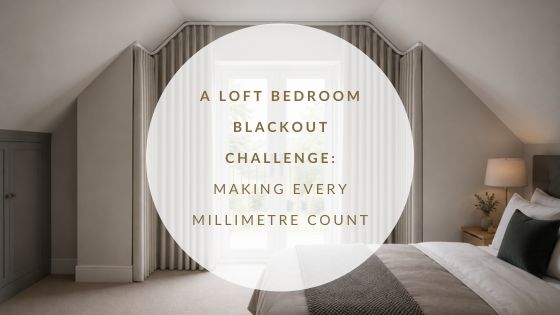
Creating a truly dark bedroom can be challenging when space is limited, particularly in loft conversions where sloping ceilings and restricted wall space leave little room for error. A recent customer enquiry highlighted how thoughtful planning and the right curtain track solution can help achieve effective blackout around French doors, even in a compact setting.
When every centimetre matters, choosing a made-to-measure curtain track can make all the difference, helping you achieve a neat finish while improving light control.
The Project
The customer was fitting curtains to French doors within a loft conversion bedroom and needed to maximise blackout performance without compromising the available space.
The opening measured just 115cm wide, with 50cm of return wall on either side. Above the doors there was minimal clearance to the ceiling, making a recessed curtain track the preferred option. The challenge was ensuring that unwanted light did not enter around the curtain edges once the curtains were closed.
Like many loft conversions, the room presented several design constraints. Sloping ceilings limited the available wall space, meaning every element of the curtain layout needed to work efficiently while maintaining a clean, unobtrusive appearance.
Why Recessed Curtain Tracks Work So Well in Loft Conversions
Loft bedrooms often have unique architectural features that make standard curtain installations more difficult. Low ceilings, roof pitches and limited fixing positions can all influence the type of curtain track that will work best.
A recessed curtain track sits neatly within the ceiling, creating a streamlined look that complements contemporary interiors while making the most of the available height above the window or doors. This discreet installation also allows curtains to hang neatly from ceiling to floor, helping to create a softer finish within the room.
For bedrooms where controlling natural light is important, careful planning of the curtain track layout can be just as important as the choice of curtain fabric itself.
Preventing Light Leakage Around the Returns
The curtain track needed to follow a two-bend 90-degree layout, allowing the curtains to continue from the main span onto the short return walls.
With the sloping ceiling restricting how far the returns could extend, more complex layouts, such as reverse bends, were not suitable. The focus instead became achieving the best possible seal against the walls to reduce light leakage.
Small details like this can make a significant difference when designing a blackout curtain system, particularly in bedrooms where light control is an important consideration.
A Simple Solution That Makes a Big Difference
During the discussion, Natalie recommended using discreet pin-and-loop end hooks fitted to the final gliders. By securing the curtain to the return wall, the fabric sits closer to the wall, helping to minimise gaps where light could otherwise enter.
The additional components do not need to be selected separately on the website. Instead, customers can simply include a note within the additional information section during checkout, allowing the manufacturing team to prepare the order accordingly.
As Natalie explained:
"End hooks."
Sometimes the simplest solutions are the most effective, particularly when they can improve the finished result without requiring a more complex curtain track design.
The Recommended Curtain Track
For this installation, the recommended system was the Silent Gliss 6243 recessed curtain track, chosen for its slim recessed profile and ability to accommodate a compact 10cm bend radius.
Every track is made to measure, using professional bending services and excellent craftsmanship to ensure the bends are manufactured accurately for smooth curtain operation and a precise fit. This attention to detail is particularly valuable in installations where the curtain needs to follow precise angles around corners or bay-style returns.
Production was confirmed at approximately five working days, with each track manufactured specifically to the customer's measurements.
Planning Your Measurements
Accurate measurements are an essential part of any made-to-measure curtain track installation, especially where bends or return walls are involved.
Providing clear dimensions, together with any additional notes during the ordering process, allows the manufacturing team to produce a curtain track that has been tailored to your space. Including details such as return wall sizes, fixing positions and any ceiling restrictions can help ensure the finished installation performs exactly as intended.
If you're unsure about any aspect of your measurements, seeking advice before placing your order can help avoid unnecessary adjustments later.
Read more about measuring your widows for curtain tracks here.
What You Should Consider
- When planning a similar installation, it is worth remembering that:
- Recessed curtain tracks are well suited to rooms with limited ceiling clearance.
- Securing curtains with end hooks can help improve blackout performance by reducing light entering at the sides.
- Accurate bay window measurements and clear installation notes help ensure a made-to-measure track is manufactured correctly.
- Choosing a bespoke curtain track manufactured using professional bending services and excellent craftsmanship helps achieve a precise fit for more complex layouts.
- Expert advice can often identify simple solutions that improve the finished result without adding unnecessary complexity.
Whether you're designing a loft conversion, fitting curtains around French doors or planning a bespoke bay window, careful specification at the outset can make all the difference to both the appearance of the finished installation and the effectiveness of your blackout solution.
This entry was posted in Hints and Tips on 21/07/2026